Dr Rebel: Rigid office hours clash with creative rhythms... give your rebels room to spark ✨
Today’s question: The rebel in my team often emails whenever inspiration strikes, and I’m worried the round-the-clock messages unsettle the others
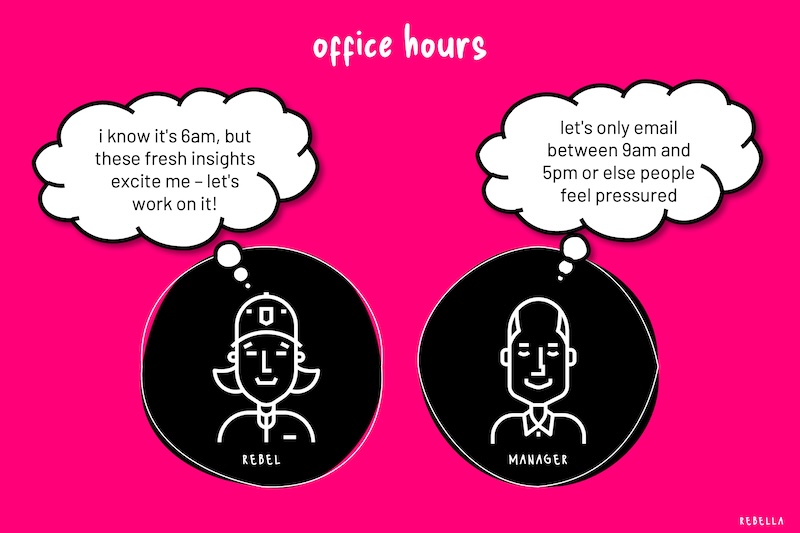
The manager is focused on psychological safety, boundaries, and equity across the team. They know that even ‘optional’ early-morning or late-night messages can create implicit pressure; people may feel they must respond immediately to be seen as committed. The manager’s mindset: predictability and boundaries protect people.
The rebel thrives on spontaneity, bursts of inspiration, and flexible work rhythms. To them, work is not strictly tied to the clock: if an idea hits at 6 am, they see acting on it as enthusiasm, not pressure. Their mindset: creativity doesn’t follow office hours.
Don’t let it fester
If these two different perspectives remain unspoken within the team, it will negatively impact the team’s collaboration, and sooner or later, it will clash:
- The rebel may feel controlled or creatively stifled; the manager may feel the rebel is ignoring team norms or creating risk. This can lead to resentment towards each other, and even end up in a conflict
- The team gets confused. If one person breaks the unwritten rules, others may wonder what the real expectations are
- Even if the rebel doesn’t intend it, others might feel obligated to match their pace
- Without conversation, everyone in the team may assume negative intent: “They don’t value flexibility” versus “They don’t respect boundaries”
Three-step team approach
This isn’t just an issue between the manager and the rebel. It affects the whole team. That is why it takes a collective effort to create an environment where everyone feels comfortable and can thrive.
Step 1: Check, check, double check
Don’t assume the other team members are bothered by the rebel’s behaviour, but ask them whether it’s actually an issue. They may be so used to it that they know exactly how to handle it. If that’s the case, let it be and allow the rebels to work in their own way. And be glad you have someone on the team who is so passionate and committed.
Step 2: Have a team conversation
If the other team members do find the behaviour disruptive, bring the team together for a conversation. Invite them to share what actually makes them feel pressured or relaxed about the rebel’s communication style. Often, a colleague’s casual comment like, ‘I love your early ideas, but I panic when I see them at 6 a.m.’, has far more impact than a manager’s directive.
Also, give the rebels space to explain why they communicate in this way. Sometimes the reasons are surprising: they may be trying to avoid distractions, feel more creative at certain hours, or worry about forgetting ideas if they don’t share them immediately.
Make sure the discussion remains constructive and does not feel like the team is ganging up on the rebel. End the session by checking in with everyone to see whether simply discussing the issue has resolved it, or whether further action is needed.
Step 3: Find solutions
If the team feels that specific actions are needed, make it a collaborative effort and ensure that both perspectives are respected, especially since the rebel(s) will likely be in the minority. Here are some suggestions for what you might do:
- Hold a team brainstorming session in which you highlight both the rebels’ spontaneous creativity and the manager’s or others’ commitment to sustainable work rhythms. Then ask, ‘How do we want these strengths to coexist?’ When the issue is framed as two strengths rather than a conflict, the conversation becomes collaborative instead of corrective.
- Run a two-week experiment, where in the first week, you allow flexible sending of messages but with clear “no need to respond” signals. In the second week, everyone uses scheduled send. Then gather feedback and evaluate. This transforms the conflict into collaborative inquiry, rather than a debate about who’s right. The rebel feels heard; the team generates data.
- Introduce a brainwave channel, such as in Teams, Slack or WhatsApp. Let the rebel and any others who work in bursts create an optional inspiration-sharing channel. Messages in that channel can be dropped at any hour, and don’t require a response. Be clear that the channel is explicitly for sharing ideas, not requests. This way, spontaneity is put into a safe container rather than suppressing it.
Don’t worry, be happy
Different working styles don’t have to divide a team; they can enrich it, as long as they’re acknowledged openly. By turning tension into conversation and experimentation, you create a culture where both structure and spontaneity can thrive. Most importantly, you show your team that differences aren’t obstacles, but opportunities to work better together.



do you have a burning question for dr rebel?